Remote work used to mean a laptop, a decent Wi-Fi password, and a tourist visa stamped every ninety days. That math no longer holds for anyone building a real life abroad. More remote professionals now want something sturdier: a legal foothold, predictable taxes, and eventually a second passport or permanent residency for their family.
Golden visa programs and digital nomad visas solve different problems, and 2026 has made the gap between them wider. Spain closed its golden visa to new applicants. Portugal reshaped its rules. Greece adjusted investment zones. Nomads weighing a move need to know which route fits their income, savings, and timeline, not just which country sounds appealing.
This guide walks through seven active programs worth knowing this year, how their costs actually compare, and when pairing a digital nomad visa with a later golden visa application makes sense. For anyone exploring residency by investment, Global Residence Index has guided clients through these exact decisions for years, and that experience shapes the comparisons ahead.
Key Takeaways
Portugal and Spain have reformed their golden visa rules, changing what digital nomads should expect in 2026.
Seven active golden visa and residency by investment programs remain realistic options for remote workers this year.
A side-by-side look at investment thresholds versus income requirements reveals which path actually costs less.
Combining a digital nomad visa with a later golden visa application can be a smart sequencing strategy.
Family inclusion rules differ significantly between digital nomad visas and golden visas, especially for children and parents.
Golden Visas vs. Digital Nomad Visas: What's Actually Different in 2026

A golden visa grants residency, and often a path to citizenship, in exchange for a qualifying investment, typically real estate, government bonds, or a business stake. A digital nomad visa grants temporary residency based on proof of remote income, usually requiring no investment at all.
Investment thresholds versus income requirements
Golden visas demand capital, often hundreds of thousands of euros, tied up for several years. Digital nomad visas demand an income threshold, often a modest multiple of local minimum wage, with no capital commitment at all.
Why the distinction matters more after 2026 reforms
With Spain's golden visa gone and Portugal's rules tightened, nomads can no longer assume investment migration is always the faster or cheaper route. Income based visas now compete directly with capital based residency.
1. Greece Golden Visa
The Greece Golden Visa remains one of Europe's most accessible residency by investment routes, though 2024 reforms raised costs in popular areas.
Current investment thresholds and regions
Investment starts at €250,000 for qualifying conversion or heritage restoration projects, rises to €400,000 in most other regions, and reaches €800,000 in high demand zones like Attica, Thessaloniki, Mykonos, and Santorini. Processing legally takes about two months after a complete file, though practical estimates run four to eight months.
Who this suits among remote workers
Nomads with real estate investment capital and an EU member state residency goal, rather than an immediate income need, tend to find this route worthwhile.
2. Spain's Digital Nomad Visa (Post-Golden Visa Closure)
Spain abolished its €500,000 property based golden visa for new applicants in April 2025, removing a once popular real estate investment route entirely.
What changed when Spain ended its golden visa
Existing holders generally keep their status and renewal rights under transitional rules, but new applicants can no longer buy their way into Spanish residency through property.
Income thresholds and renewal path
Spain's 2026 Digital Nomad Visa requires roughly €34,188 in annual foreign-sourced income for the principal applicant, about €2,849 monthly, with lower thresholds for dependents. Work must come primarily from clients outside Spain, with health insurance and a clean criminal record also required.
3. Italy Golden Visa
Italy's Investor Visa still offers one of Europe's most flexible residency by investment structures, since the capital can go into a startup, a company, or government bonds rather than property.
Investment options and timelines
The qualifying investment starts at €250,000 into an innovative Italian startup, €500,000 into an established Italian company, €2 million in government bonds, or a €1 million philanthropic donation.
Unlike Greece or Portugal, there is no real estate investment requirement here. Processing typically runs three to six months, and the residency carries no minimum stay for renewal, which suits nomads who travel constantly but still want an EU member state foothold.
4. Portugal's Reformed Golden Visa and D8 Digital Nomad Visa
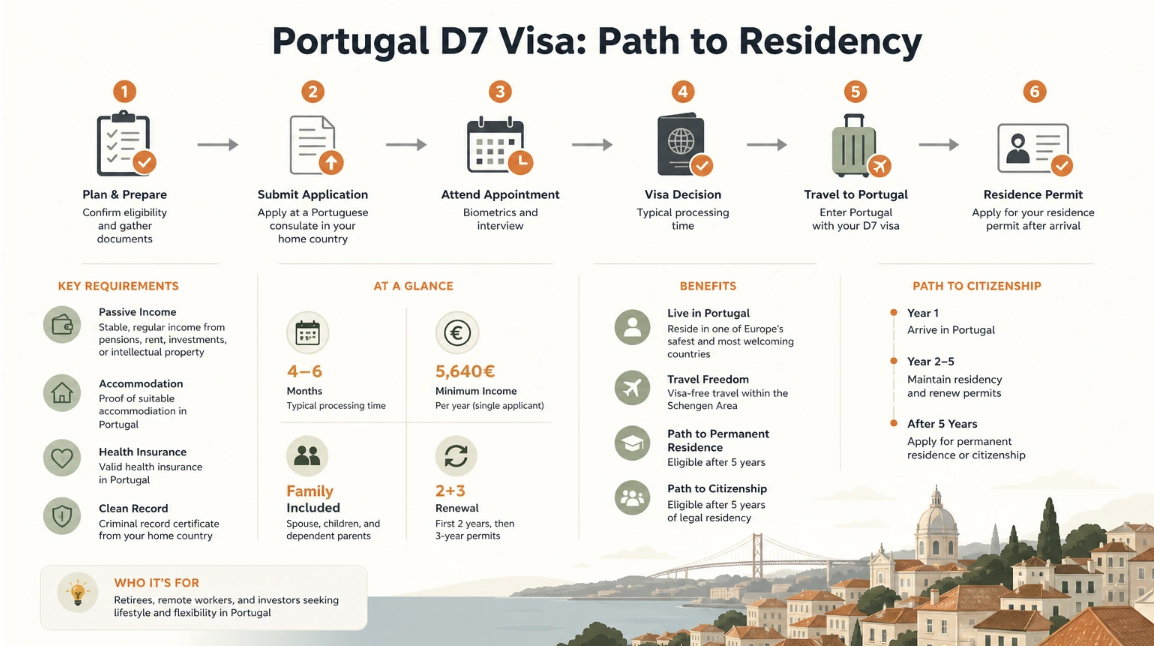
Portugal's golden visa remains active but has moved decisively away from residential property since the 2023 reforms tightened eligible routes.
How the 2023-2026 reforms reshaped eligibility
Residential real estate investment no longer qualifies. Capital must now flow into investment funds, business creation, job creation, or scientific research, which changes the profile of who applies.
Pairing the D8 visa with a later golden visa application
Many remote workers enter Portugal first on the D8 digital nomad visa, which has a lower income threshold and no capital outlay, then pursue the Portugal Golden Visa once settled and capitalized. This sequencing can ease both the financial and bureaucratic burden, though anyone considering it should consult Global Residence Index, which has guided clients through both Portuguese pathways and understands how the two interact for long-term residency and eventual citizenship planning.
5. Malta Permanent Residency Programme
Malta's Permanent Residence Programme offers one of the few routes in Europe to immediate permanent residency rather than a renewable temporary permit.
Qualifying investment and path to citizenship
Current planning figures range roughly from €169,000 to €474,000, depending on whether property is purchased or leased, plus a government contribution and approved health insurance. Permanent residency here does not automatically convert into a path to citizenship, but it does offer a stable EU member state base without renewal cycles common elsewhere.
6. Mexico Temporary Resident Visa for Remote Workers
Mexico's Temporary Resident Visa has become a favorite among nomads seeking low cost of living alongside a workable residency option, without the capital demands of a golden visa.
Income threshold and renewal requirements
Applicants typically show consistent monthly remote income or savings, with figures set by individual consulates rather than a single national threshold. The visa runs for up to four years with renewal requirements tied to continued income proof, after which permanent residency becomes possible for those who stay.
7. UAE Golden Visa and Remote Work Visa
The UAE offers two distinct tracks worth separating clearly, since nomads often confuse them. The Golden Visa grants ten-year renewable residency, most commonly through a real estate investment of roughly AED 2 million, about US$545,000 at current conversion.
Ten-year residency without property purchase in some tracks
Alternative routes exist for entrepreneurs, public investors, and exceptional talent, meaning property purchase is not always required. Separately, the UAE's remote work visa allows nomads earning qualifying remote income to live in Dubai or Abu Dhabi for one renewable year, without any qualifying investment at all. For long-term planners, the Golden Visa suits those ready to commit capital for a decade-long base with no personal income tax, while the remote work visa fits shorter stays. Health insurance remains mandatory under both tracks.
Cost Comparison: Minimum Investment vs. Income Thresholds, Side by Side
Comparing these seven programs side by side exposes a pattern. Golden visa routes demand upfront capital, often €250,000 to €2 million, while digital nomad visas demand proof of recurring income with little or no qualifying investment.
Reading the table: what counts as true cost
The minimum investment figure rarely reflects the full cash requirement. Legal fees, due diligence, property transfer charges, and renewal costs add meaningfully to every golden visa budget.
Where tax residency enters the calculation
Tax residency rules often matter more than the sticker price. A program with a lower investment threshold can still cost more annually if it taxes worldwide income rather than foreign-sourced income only.
The Hybrid Strategy: Using a Digital Nomad Visa as a Stepping Stone to a Golden Visa
Entering on a digital nomad visa before committing capital to a golden visa is becoming a common relocation strategy among remote workers with growing remote income.
Sequencing for tax optimization
This approach allows time to establish tax residency gradually, test a country's lifestyle, and build local banking history before a larger investment migration decision.
When this strategy backfires
It backfires when a digital nomad visa triggers unwanted tax residency sooner than expected, or when physical presence requirements conflict with a traveling lifestyle. Professional guidance before switching tracks matters, which is why consulting Global Residence Index before pursuing a golden visa programs for digital nomads strategy helps clarify sequencing risks specific to each country pair.
Worked Example: Tax Exposure Under Each Visa Type for the Same Income

A $150,000 remote income scenario compared
Consider a remote worker earning $150,000 annually. Under a digital nomad visa with foreign-sourced income exemptions, that income may face minimal local tax. Under full tax residency via a golden visa, the same income could become subject to worldwide income taxation, depending on the country and any applicable treaty. American citizens must still weigh FATCA and FBAR reporting obligations regardless of residency, and some ultimately consider expatriation or domestic options like Act 60 Puerto Rico before pursuing a second residency abroad. A qualified tax advisor should model each scenario individually.
Family Inclusion: Children, Parents, and Age Limits Across Visa Types
Family inclusion rules vary sharply between visa types. Digital nomad visas typically cover spouses and dependent children, sometimes up to age 25 if enrolled in education. Parents are rarely included.
Golden visa programs tend to be more generous. Spouses, dependent children, and often financially dependent parents or grandparents can qualify under a single application, with family inclusion built into the broader path to citizenship timeline many applicants plan around.
This difference matters for multigenerational households. Those bringing parents abroad should verify eligibility carefully, since a digital nomad visa suited to a solo remote worker may fall short for an extended family.
Exit Risk: What Happens If a Program Closes or a Visa Isn't Renewed
Spain's golden visa closure in 2025 showed how quickly rules shift. Existing holders generally kept grandfathered rights, but new applicants lost that route entirely overnight.
Renewal failure carries real consequences: loss of tax residency status, disrupted schooling, and reapplication under tighter current rules. Programs can tighten thresholds or close without much warning.
Protecting against this means diversifying timelines, keeping documentation current, and avoiding reliance on a single program. A trusted advisor tracking policy shifts across multiple countries remains the strongest safeguard against exit risk.
—
Note: this article was provided by a partner